
WordPress Users Are Migrating to Proactive Security in 2026
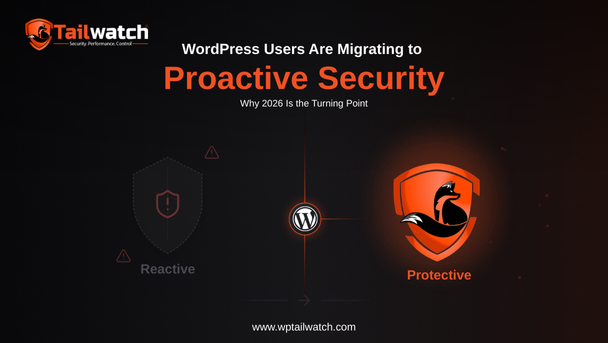
Reactive security waits for something to break, then alerts you to clean it up. Proactive security prevents attacks at the edge, scans continuously, and remediates automatically before damage spreads. In 2026, WordPress owners are abandoning scan-and-notify plugins for tools that act on their behalf, because by the time you get the alert, it's often already too late.
There's a quiet migration happening in the WordPress world, and it has nothing to do with hosting. Site owners are changing what they expect security software to do. The old model, scan, detect, email you a problem, is being replaced by tools that prevent attacks up front and fix what slips through automatically. Here's why that shift is accelerating, and what it means for how you protect your sites.
What "reactive" security actually looks like
Reactive security is the model most of us grew up with on WordPress. You install a plugin. It scans on a schedule. When it finds something wrong, it sends a notification. Then the clock starts ticking on you:
- You read the alert (hopefully soon, not days later).
- You research what the threat is and whether it's a false positive.
- You manually clean infected files, or pay someone to.
- You hope nothing was exfiltrated, defaced, or blocklisted in the meantime.
The fatal flaw is the gap between detection and resolution. During that window, often hours, sometimes days, your site is still compromised. It may be serving malware to visitors, sending spam, or sitting on Google's blocklist quietly tanking your traffic.
Why reactive isn't enough anymore
Attacks against WordPress are overwhelmingly automated. Bots probe millions of sites a day, weaponising newly disclosed vulnerabilities within hours of publication. The defender's window has collapsed.
Sucuri's analysis of compromised websites has consistently found that the majority of hacked sites had out-of-date software or no active monitoring at the time of infection, a textbook reactive posture. Source: Sucuri Website Threat Reports
When exploitation is automated and instant, human-in-the-loop response simply can't keep pace. By the time a person reads the email and reacts, the bot has already done its work. Proactive security closes that gap by removing the human from the critical path.
What "proactive" security does differently
Proactive security is built around a simple principle: prevent first, remediate automatically, notify last. In practice that means three layers working together.
1. Prevention at the edge
A firewall blocks malicious requests, exploit attempts, and bad bots before they reach WordPress. Vulnerability intelligence updates continuously, so the moment a plugin flaw is disclosed, virtual patching shields your site even before the official update lands. The best attack is the one that never connects.
2. Continuous monitoring, not scheduled scans
Instead of scanning once a day, proactive tools watch file integrity, logins, and traffic in real time. A change to a core file or an anomalous login is caught the instant it happens, not at the next scan window.
3. Automatic remediation
This is the part that redefines the category. When malware is found, a proactive platform removes it automatically and redeploys clean files, no ticket, no manual cleanup, no waiting. WP Tailwatch's AI Malware Guard is built on exactly this idea: the alert you receive says "handled," not "your move."
The mindset shift behind the migration
What's really changing is the expectation. Site owners no longer want a tool that's good at telling them they've been hacked. They want one that quietly makes sure they aren't, and cleans up instantly if they are. Security is moving from a thing you babysit to a thing that runs itself.
This is also why the mobile-first model is winning. Proactive security only works when prevention, monitoring, and remediation share one brain and one dashboard. Five disconnected plugins can't coordinate a real-time response; one platform can, and it can ping your phone the instant it acts. If you're weighing the switch, our honest comparisons show how the reactive scan-and-notify tools stack up against a proactive platform.
The migration to proactive WordPress security in 2026 isn't hype. It's the natural response to a threat landscape that no longer gives humans time to react.

Stop reacting. Start preventing.
Prevention at the edge, continuous monitoring, and automatic malware removal, with alerts that say "handled." Start free.
- Free forever plan
- No credit card
- 14-day money-back on paid plans